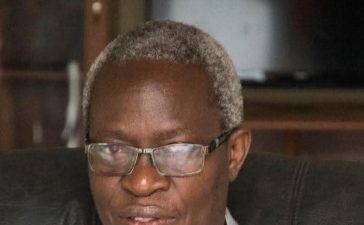


Once again, Norman Chisale, the ever-controversial bodyguard turned Deputy Minister of Homeland Security, has entered the public arena—not to debate ideas, but to attack a person.
This time, his target is UTM President Dr. Dalitso Kabambe.
Kabambe’s so-called offense is straightforward: he criticised the DPP-led government for raising fuel prices. As an economist and former Governor of the Reserve Bank of Malawi, Kabambe warned that higher fuel prices increase transport costs, raise food prices, and push up the overall cost of living. The result is simple—ordinary Malawians suffer. This is a policy-based, evidence-driven argument, and it deserves a serious response.
Chisale did not offer one.
Instead of explaining why fuel prices should rise or challenging Kabambe’s economic reasoning, Chisale resorted to personal attacks. He dismissed Kabambe as politically irrelevant simply because he failed to win a parliamentary seat and went further to claim that Kabambe is not even fit to be elected as a councillor.
This is not debate. It is political noise.
In any healthy democracy, arguments are answered with counter-arguments, not insults. If Kabambe’s analysis is wrong, the burden lies on Chisale to show where the facts or logic fail. His inability to do so explains why he chose character assassination over reasoned engagement.
Unsurprisingly, many Malawians on social media reacted with ridicule and criticism. They described Chisale’s remarks as crude, immature, and far below the standard expected from a senior government official. The contrast was clear: a trained economist who once led the country’s central bank versus a politician unable—or unwilling—to engage with basic economic realities.
Chisale’s outburst highlights a deeper problem in Malawi’s politics: a culture that rewards loyalty and aggression rather than competence and ideas. In a functioning democracy, policy disagreements are settled through facts, logic, and evidence. Chisale offers none of these. What he offers instead is volume without substance.
Fuel prices are rising. The cost of living is climbing. Malawians deserve leaders who can explain policies, defend decisions, and respond intelligently to criticism. When a government official answers a serious economic concern with personal insults, he does not weaken his opponent’s argument—he confirms it.
In the end, Chisale’s response tells us more about his limitations than about Kabambe’s influence. It exposes a man who does not understand the rules of a healthy debate and who has nothing meaningful to contribute to one.