
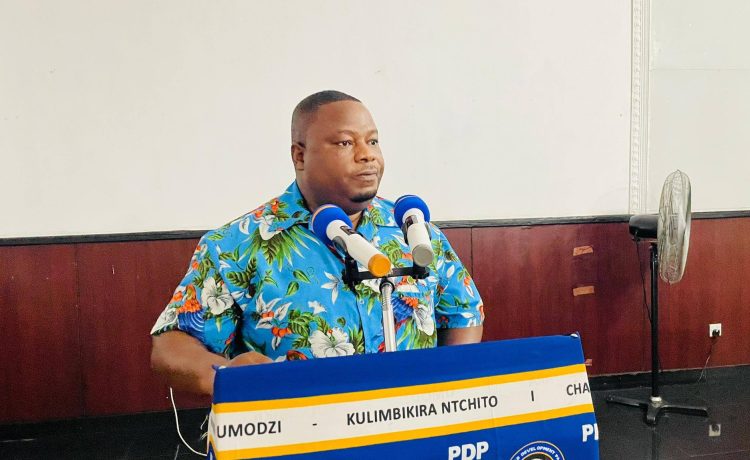
The People’s Development Party (PDP), led by Kondwani Nankhumwa, has once again found itself in the political spotlight—though not necessarily because of its strength.
PDP has confirmed that it will take part in the Nkhotakota-Luwaladzi parliamentary by-election scheduled for 17 next month. The announcement was made by Nankhumwa himself following a meeting of the party’s National Executive Committee held in Salima. According to the party, the meeting reviewed its performance in the 16 September 2025 general election and discussed preparations for the 2030 elections.
On paper, PDP’s decision is within its constitutional right. Any registered political party is free to contest elections. But in political reality, PDP remains one of Malawi’s weakest parties. After the last general election, the party emerged with only one Member of Parliament—Nankhumwa himself. In effect, it is a one-man parliamentary party, often described by critics as a “briefcase party” with no meaningful national footprint.
This raises a serious question: what influence does PDP really bring to the race?
Nankhumwa says the party will use the campaign to sell its development agenda to the people of Nkhotakota. He argues that PDP stands for unity, food security, and hard work. The party also claims it plans to introduce community-based development projects and to strengthen its structures by providing vehicles to its regional governors.
These promises sound familiar—and ambitious. However, they sit uneasily with the party’s limited capacity. With no councillors, no significant parliamentary presence, and no visible grassroots structures, PDP’s participation looks more symbolic than strategic. Critics argue that the party’s involvement will add little value to a contest widely expected to be dominated by DPP and MCP.
Ironically, while PDP is entering the race, some observers believe the UTM Party, which is currently in a rebuilding phase, would have been better placed to contest the by-election as part of its political revival. Even then, most analysts agree that the seat remains firmly within the DPP–MCP battleground.
Still, PDP insists that contesting elections is part of its long-term strategy toward 2030. Whether that strategy is grounded in political realism or mere survival remains to be seen.
For now, PDP’s participation may exercise its democratic right—but it also highlights the widening gap between political ambition and political relevance in Malawi’s crowded party landscape.