

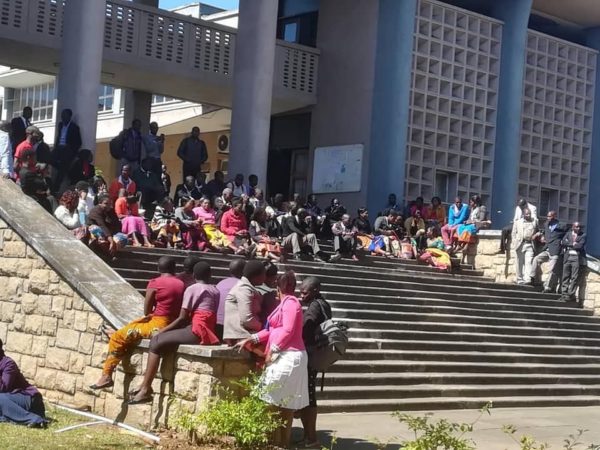
Blantyre, Malawi — What began as a day of celebration at the High Court in Blantyre quickly turned into one of anger, disbelief and profound disappointment, after the Chief Justice abruptly halted the long-awaited admission of new law graduates to the bar.
For many of the graduates—drawn from the University of Malawi and the Catholic University—the event was supposed to mark the culmination of years of training, examinations and sleepless nights. Some arrived at the court in full legal regalia; others brought relatives who had travelled from districts as far as Kamenyagwaza, Chipoka and Goliyo to witness the milestone.
The mood outside the courtroom was festive. Hundreds of graduates packed the grounds, cameras flashed, and the national broadcaster, MBC, became an informal stage as families posed proudly.
But the atmosphere shifted dramatically the moment the Chief Justice entered the courtroom. Before the ceremony could begin, the Attorney General rose and made an unexpected request: he asked the Chief Justice to adjourn the matter. His office, he said, was in discussions with the Malawi Law Society (MLS) to resolve concerns over the graduates’ eligibility for admission.
The announcement landed like a shockwave.
Murmurs filled the courtroom. Some graduates stood frozen, arms folded in disbelief, as if trying to steady themselves against the news. A few stared at the floor. Others looked toward the bench, silently appealing for an explanation.
The Chief Justice, after a brief consultation, granted the adjournment—effectively suspending all scheduled admissions for the week. For many, it was yet another postponement in a series of delays stretching back months.
A Growing Rift in the Legal Profession
At the center of the controversy is a dispute between the Malawi Law Society and the institutions that trained the graduates. The MLS maintains that the new lawyers should undergo an additional year of legal training at the Malawi Institute of Legal Education (MILE), despite having already completed their degrees.
Critics argue that the stance is unprecedented and discriminatory, especially because most members—and nearly all leaders—of the Malawi Law Society graduated from the University of Malawi’s own law program under similar training structures. To many observers, the inconsistency is difficult to ignore.
“Substance should matter more than form,” one lecturer familiar with the syllabus noted. “These graduates were taught by the same lecturers, under nearly the same curriculum the current lawyers had. To now draw a line of exclusion raises serious questions.”
The MLS has not publicly detailed the specific deficiencies it perceives in the graduates’ training, but the insistence on an additional compulsory year has been widely criticized as burdensome, unnecessary, and potentially motivated by institutional rivalry.
Human Cost of the Standoff
For the graduates and their families, the emotional toll is mounting.
One guardian who had travelled for the ceremony described the experience as “deeply painful,” saying the recurring postponements were inflicting avoidable distress. “The injustice feels too much,” he said, expressing concern about the impact such uncertainty could have on young professionals who expected to begin their careers.
Some graduates worry about missing job placements already lined up, particularly positions conditioned on bar admission. Others face financial strain, having already invested heavily in their education and preparation.
A Profession at a Crossroads
The confrontation has laid bare wider tensions in Malawi’s legal system—between tradition and reform, between long-established institutions and emerging universities, and between professional gatekeeping and equitable access.
To many watching the saga unfold, the events at the High Court represent more than a procedural delay; they signal a moment of reckoning for the legal profession itself.
For now, the adjournment stands, and the future remains uncertain. What is clear is that hundreds of young graduates—who arrived expecting to take their oath as officers of the court—went home with questions that no official has yet answered.
Whether the dispute resolves through negotiation or further legal action, the pressure on the Malawi Law Society and the judiciary to restore clarity, fairness and confidence in the admission process has never been greater.